
QU'EST-CE QUE TU CHERCHES?

WMS cloud vs WMS sur site : quel modèle de déploiement convient le mieux à votre entrepôt ? (2026)
Choisir un WMS ne se résume pas à choisir des fonctionnalités.
Vous devez également décider où le système sera exécuté.
Pour la plupart des entreprises, cela signifie choisir entre :
et
Système de gestion d'entrepôt (WMS) sur site
Les deux systèmes peuvent prendre en charge la réception, le rangement, l'inventaire, la préparation de commandes, l'expédition, la lecture de codes-barres, les opérations sur terminaux portables PDA et l'intégration ERP.
La différence réside principalement dans la manière dont le système est hébergé, maintenu, accessible et contrôlé.
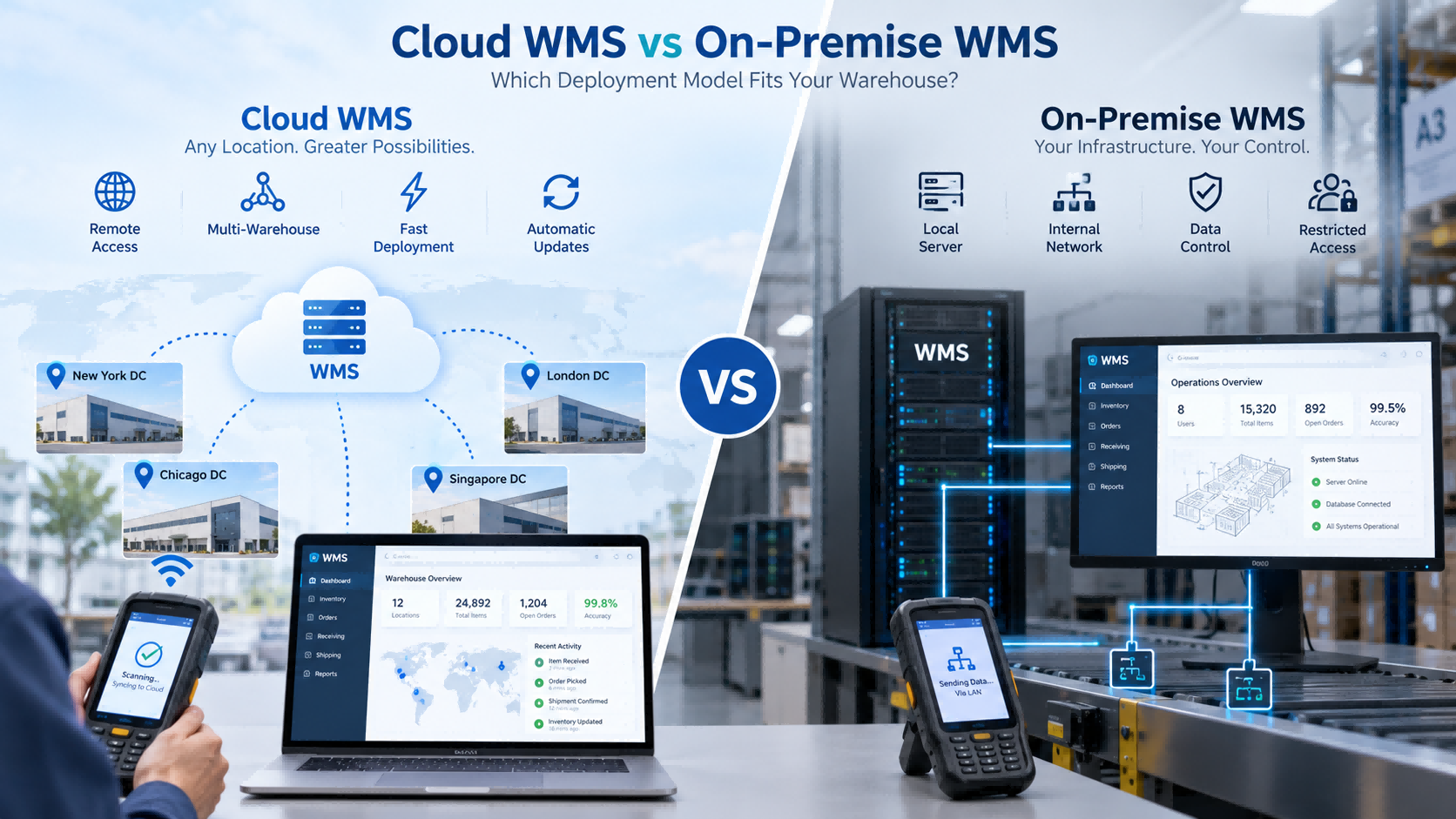
Choisissez Cloud WMS si vous le souhaitez :
Choisissez un WMS sur site si vous avez besoin de :
Pour de nombreux entrepôts de petite et moyenne taille, le cloud est une solution plus simple pour commencer.
Mais si votre politique informatique exige que le système reste au sein de votre propre réseau, la décision change immédiatement.
Cloud WMS est hébergé sur une infrastructure cloud et est généralement accessible via un navigateur ou une connexion réseau.
Les exploitants d'entrepôts peuvent toujours utiliser le même matériel :
La différence réside dans l'emplacement du système central.
Une structure typique est :
PDA → Réseau → WMS Cloud
Le déploiement dans le cloud est souvent choisi par les entreprises qui souhaitent un déploiement plus rapide, un accès centralisé et une maintenance réduite des serveurs locaux.
Le WMS sur site s'exécute au sein de l'environnement informatique du client.
Une structure typique est :
PDA → Réseau interne → Serveur local
Cela signifie généralement que le client est responsable d'une plus grande partie de l'infrastructure, notamment :
Ce modèle est souvent choisi lorsque le système doit rester à l'intérieur d'un réseau interne ou lorsque la politique de l'entreprise limite l'accès externe.
| Facteur | Cloud WMS | Système de gestion d'entrepôt (WMS) sur site | |
| Déploiement | Généralement plus rapide | Préparation accrue des infrastructures | |
| Serveur local | Généralement non requis | Généralement requis | |
| Maintenance informatique | charge interne réduite | Plus de responsabilités internes | |
| Accès multisite | Plus facile | Cela dépend de la conception du réseau | |
| Accès à distance | Plus facile | Nécessite une configuration | |
| Mises à jour | Généralement géré par le fournisseur | Généralement géré par le client | |
| Environnement de données | hébergé dans le cloud | Contrôlé par le client | |
| Réseau interne uniquement | Moins adapté dans certains cas | Souvent plus adapté | |
| Évolutivité | Plus facile à étendre | Cela dépend des infrastructures locales |
Ce tableau donne un aperçu rapide, mais la décision finale dépend généralement de votre environnement informatique.
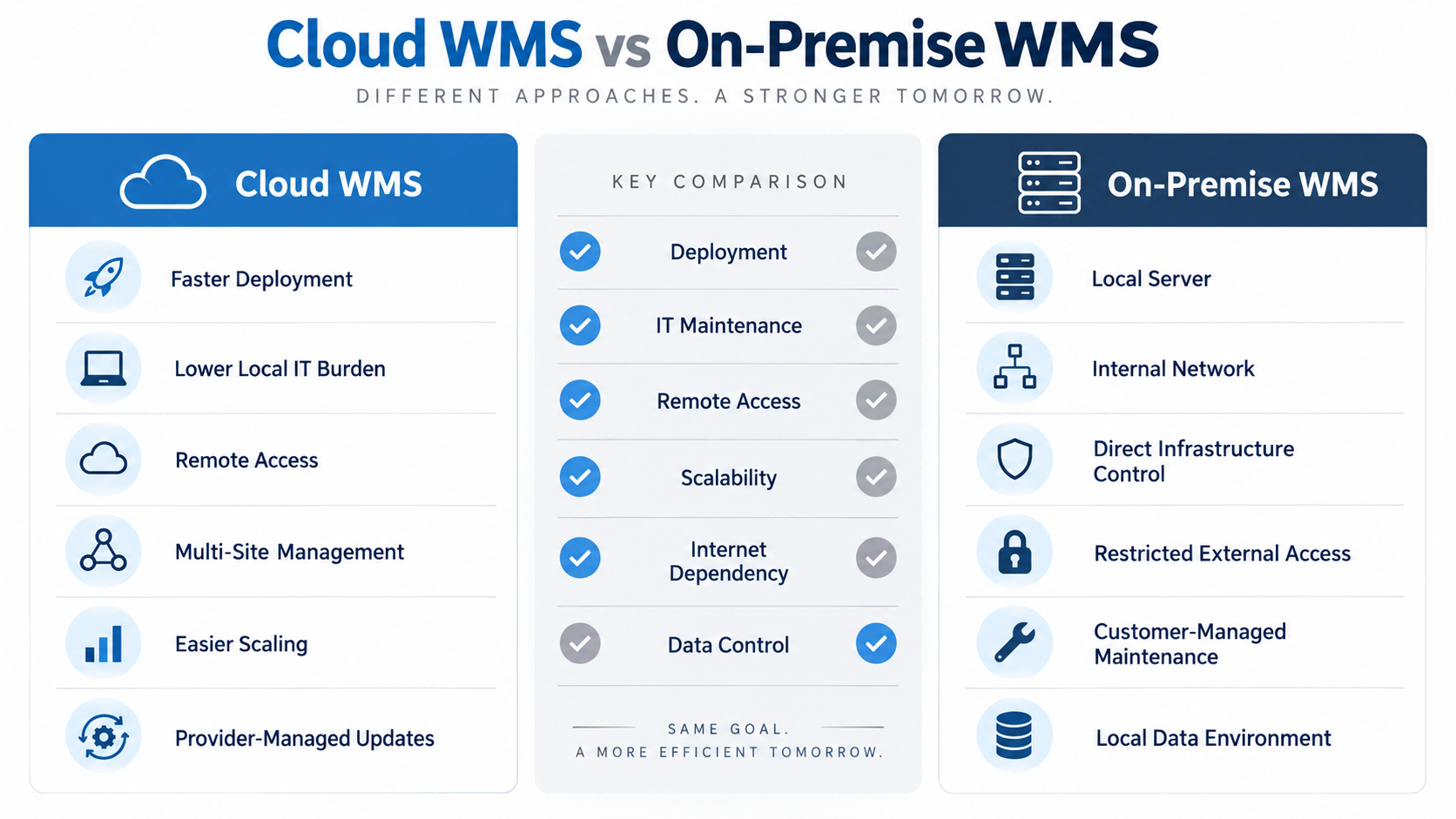
Le WMS cloud réduit généralement le besoin de construire une infrastructure serveur locale avant le lancement.
Cela peut accélérer la mise en œuvre, notamment pour les petites entreprises sans équipe informatique dédiée.
La préparation sur site nécessite davantage de préparation.
L'organisation pourrait avoir besoin de configurer :
Le coût fonctionne également différemment.
Le WMS cloud implique généralement un abonnement logiciel, des utilisateurs, des modules, une implémentation et du matériel connecté.
Une solution sur site peut nécessiter une infrastructure initiale plus importante et une maintenance interne continue.
La question importante n'est pas simplement :
Lequel est le moins cher ?
Une meilleure question serait :
Quel modèle engendrera le moins de charge de travail et de coûts informatiques totaux pour notre entreprise au cours des prochaines années ?
Dans le cadre d'un projet d'entrepôt FYJ en Thaïlande, le client traitait environ 500 commandes par jour et environ 3 000 références.
Le projet a utilisé un WMS Cloud associé à l'impression et à la lecture de codes-barres, aux alertes de réapprovisionnement, à la gestion ABC et des stocks à rotation lente, aux fonctions multi-entrepôts et à la préparation de commandes mobile.
Après la mise en œuvre :
Pour ce type d'opération, le déploiement dans le cloud était judicieux car l'entrepôt nécessitait un accès centralisé, mobile et multi-entrepôts sans avoir à construire un environnement serveur local plus complexe.
C’est là que le WMS cloud présente souvent un avantage pratique.
Si une entreprise exploite plusieurs entrepôts, le déploiement dans le cloud facilite l'utilisation de la même plateforme par le siège social et les différents sites.
La direction peut consulter :
sans maintenir de systèmes locaux distincts.
L'infrastructure sur site peut également prendre en charge plusieurs entrepôts, mais l'entreprise a généralement besoin d'une planification réseau interne plus poussée entre les sites.
Pour un entrepôt unique, cette différence peut ne pas avoir beaucoup d'importance.
Pour cinq ou dix sites, cela devient beaucoup plus important.
C'est l'une des questions les plus pratiques que les acheteurs devraient se poser.
Le système de gestion de contenu cloud (WMS) dépend davantage de la connectivité réseau.
Avant de faire votre choix, posez-vous les questions suivantes :
Pour les entrepôts disposant d'une connexion internet instable, cela peut s'avérer plus important que de nombreuses fonctionnalités logicielles.
Les systèmes sur site peuvent souvent continuer à fonctionner au sein du réseau local, selon leur architecture.
Dans certains projets FYJ, le modèle de déploiement est en fait décidé avant même que les fonctionnalités logicielles ne soient abordées.
Si les exigences du client comprennent :
Dans ce cas, le déploiement dans le cloud pourrait déjà être inadapté.
La gamme de logiciels de FYJ prend en charge à la fois le déploiement dans le cloud et le déploiement local/privé, permettant ainsi de choisir l'architecture en fonction de l'environnement informatique du client.
C'est un point important :
Le choix d'une solution sur site ne doit pas se faire simplement parce qu'elle « semble plus sécurisée ».
Il convient de choisir cette option lorsque le contrôle local est une réelle nécessité.
L'intégration ERP ne dépend pas uniquement du modèle de déploiement.
Les WMS cloud et sur site peuvent tous deux s'intégrer aux ERP si les systèmes fournissent des interfaces appropriées.
Avant la mise en œuvre, définir :
Si ces questions ne sont pas claires, les employés risquent de saisir deux fois la même transaction.
Cela contredit l'une des principales raisons de l'introduction du WMS.
Généralement, pas grand-chose.
Les deux modèles peuvent utiliser :
L'opérateur d'entrepôt peut effectuer exactement la même action :
Scanner le produit → Scanner l'emplacement → Confirmer la quantité
Ce qui change, c'est l'endroit où vont les données.
Nuage
PDA → Réseau → WMS Cloud
Sur site
PDA → Réseau interne → Serveur local
Le choix entre le cloud et l'infrastructure sur site est donc principalement une décision d'architecture logicielle, et non une décision relative au matériel d'entrepôt de données.
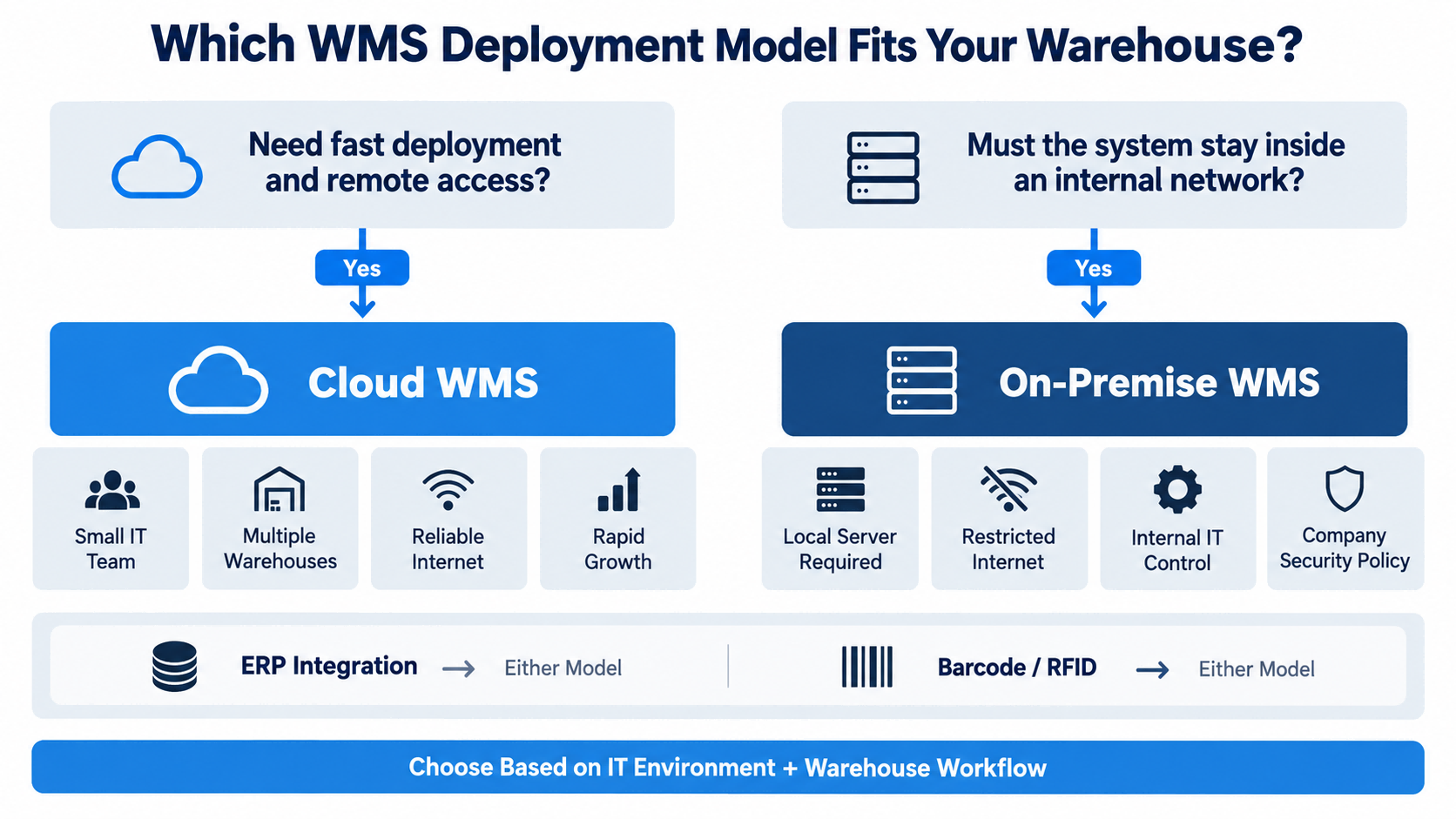
Choisissez Cloud WMS lorsque :
Choisissez un WMS sur site lorsque :
Si les deux modèles sont techniquement possibles, comparez alors le coût total, la charge de travail informatique, l'évolutivité et les besoins d'intégration futurs.
| Votre situation | Meilleur point de départ |
| Petite équipe informatique | Cloud WMS |
| Déploiement rapide nécessaire | Cloud WMS |
| Plusieurs emplacements d'entrepôt | Cloud WMS |
| Accès à distance requis | Cloud WMS |
| Expansion rapide prévue | Cloud WMS |
| Réseau interne uniquement | Sur site |
| Serveur local requis | Sur site |
| Internet externe restreint | Sur site |
| L'entreprise contrôle l'infrastructure informatique | L'option sur site peut convenir |
| Intégration ERP requise | Soit |
| Code-barres ou RFID requis | Soit |
| Internet instable Évaluer | Fonctionnalités sur site ou hors ligne |
Avant de décider, posez-vous les questions suivantes :
Si un fournisseur ne peut pas répondre clairement à ces questions, l'architecture de déploiement n'est probablement pas encore entièrement définie.
FYJ prend en charge le déploiement de la gestion d'entrepôts aussi bien dans le cloud qu'en local.
Le choix commence généralement par quelques questions pratiques :
Le modèle de déploiement est sélectionné une fois ces exigences clairement définies.
En pratique, nous ne recommandons pas le Cloud ou l'On-Premise simplement parce que l'un est plus récent.
Le système doit s'adapter à la fois au flux de travail de l'entrepôt et à l'environnement informatique du client.
Le WMS cloud est-il meilleur que le WMS sur site ?
Pas toujours. Un WMS cloud est souvent plus facile à déployer et à maintenir. Une solution sur site est plus adaptée lorsqu'un contrôle du réseau interne ou du serveur local est nécessaire.
Le WMS cloud est-il moins cher ?
Cela peut réduire les coûts d'infrastructure initiaux, mais le coût total dépend toujours des abonnements, des utilisateurs, de l'intégration, du matériel et de l'exploitation à long terme.
Le système de gestion de contenu cloud (WMS) nécessite-t-il un accès Internet ?
Généralement oui. Demandez si le système ou l'assistant numérique personnel (PDA) prend en charge les flux de travail hors ligne en cas d'interruption de la connexion.
Un WMS sur site est-il plus sécurisé ?
Pas automatiquement. Cela donne au client un contrôle plus direct sur l'environnement local, mais la sécurité réelle dépend de la conception du système, du contrôle d'accès, de la maintenance et de la gestion informatique.
Les deux modèles sont-ils compatibles avec un ERP ?
Oui, si des API ou des méthodes d'intégration appropriées sont disponibles.
Les solutions WMS Cloud et On-Premise peuvent-elles toutes deux prendre en charge les codes-barres et la RFID ?
Oui. Les codes-barres et la RFID sont des technologies de collecte de données et peuvent être utilisés avec les deux modèles de déploiement lorsqu'ils sont pris en charge par le logiciel.
Les solutions WMS cloud et WMS sur site peuvent toutes deux prendre en charge efficacement les opérations d'entrepôt.
Pour de nombreux entrepôts en pleine croissance, le WMS cloud est plus facile à déployer et à faire évoluer.
Pour les organisations disposant de réseaux internes contrôlés ou d'exigences strictes en matière d'infrastructure locale, une solution sur site peut s'avérer le choix le plus pratique.
La question clé n'est pas :
Quel modèle est le meilleur ?
C'est:
Quel modèle correspond le mieux à notre environnement informatique, à notre flux de travail en entrepôt et à notre croissance future ?
C’est cette décision qui devrait guider le projet WMS.
Hi! Click one of our members below to chat on
 fr
fr 


 Réseau IPv6 pris en charge